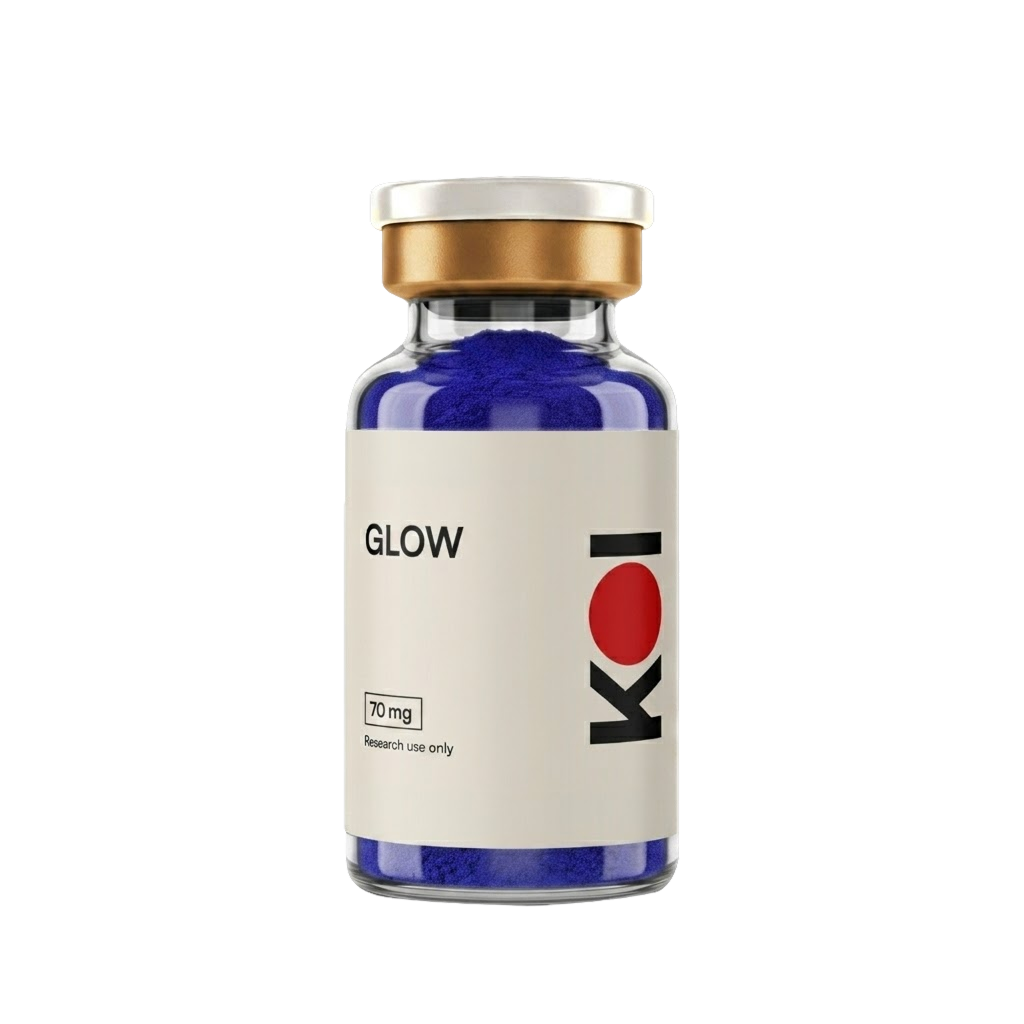
What is GLOW Blend?
GLOW Blend is a research-grade three-peptide repair blend supplied in a single co-lyophilized vial — GHK-Cu (50 mg), BPC-157 (10 mg) and TB-500 (10 mg), 70 mg combined. Each component is studied for a different layer of the regenerative cycle: GHK-Cu for copper-mediated extracellular-matrix and collagen signaling, BPC-157 for angiogenic and growth-factor pathways, and TB-500 (acetylated Thymosin Beta-4) for actin-driven cell migration.
Research areas where laboratories buy GLOW for in vitro work include how the three peptides interact at fibroblast signaling and extracellular-matrix deposition, single-peptide versus multi-peptide comparisons on fibroblast migration and proliferation, NO / VEGFR2 and FAK-paxillin pathway activity in soft-tissue-repair models, and copper-mediated antioxidant-pathway profiling. The material supplied here is research-grade for in vitro laboratory study only.
Every lot, independently verified
Reported31 May 2026
Endotoxin (USP <85>)Within limits ✓
Compound information
Chemical & structural reference data — specifications, molecular profile and handling.
Product Specifications
Molecular Profile
Storage & Handling
In solution2–8 °C; aliquot & freeze
GLOW Blend Mechanism of Action
- GHK-Cu — copper-bound tripeptide studied for collagen, decorin and matrix-metalloproteinase gene expression in dermal fibroblasts.
- BPC-157 — pentadecapeptide studied for NO / VEGFR2 and FAK-paxillin pathway activity in soft-tissue-repair models.
- TB-500 — acetylated Thymosin Beta-4 studied for actin-binding and cell migration in wound-healing and cardiac models.
- Together the three are studied across distinct stages of the regenerative cycle — matrix remodeling, angiogenic signaling and cell migration.
GLOW Blend Research Applications
- How GHK-Cu, BPC-157 and TB-500 interact at fibroblast signaling and extracellular-matrix deposition in vitro.
- Gene-expression changes in dermal fibroblast cultures — collagen, decorin, matrix-metalloproteinase regulation.
- Nitric-oxide (NO), VEGF / VEGFR2 and FAK-paxillin pathway activity in soft-tissue-repair models.
- Actin-binding and cell-migration activity of Thymosin Beta-4 in wound-healing and cardiac-tissue models.
- Single-peptide vs multi-peptide activity on fibroblast migration, proliferation and ECM deposition.
- Copper-mediated antioxidant-pathway activity and comparative stability of the three peptides.
Why Buy GLOW Blend from Koi Peptides?
- Every batch of Koi GLOW Blend is synthesized and lyophilized in the United States, then released against independent third-party laboratory (Freedom Diagnostics Testing) testing.
- Each lot is tested by HPLC for purity, LC-MS for identity confirmation, and endotoxin assay for sterility readiness.
- The lot ID is printed on every vial and ties back to a public COA library, so researchers can verify documentation before they buy and after the vial arrives.
- Orders placed before 2 PM CT ship the same business day, and shipping is free on orders over $200.
- Pickart, L., & Margolina, A. (2018). Regenerative and protective actions of the GHK-Cu peptide. International Journal of Molecular Sciences, 19(7), 1987. doi.org/10.3390/ijms19071987
- Seiwerth, S., et al. (2021). Stable gastric pentadecapeptide BPC 157 and wound healing. Frontiers in Pharmacology, 12, 627533. doi.org/10.3389/fphar.2021.627533
- Goldstein, A. L., et al. (2005). Thymosin β4: actin-sequestering protein moonlights to repair injured tissues. Trends in Molecular Medicine, 11(9), 421–429. doi.org/10.1016/j.molmed.2005.07.004
- Pickart, L., & Thaler, M. M. (1973). Tripeptide in human serum that prolongs survival of normal liver cells. Nature New Biology, 243(124), 85–87. doi.org/10.1038/newbio243085a0
- Sikirić, P., et al. (2018). Stable gastric pentadecapeptide BPC 157 — vascular and organoprotective effects. Current Pharmaceutical Design, 24(18), 1990–2001. doi.org/10.2174/1381612824666180712110447
- Bock-Marquette, I., et al. (2004). Thymosin β4 activates ILK and promotes cardiac cell migration, survival and repair. Nature, 432(7016), 466–472. doi.org/10.1038/nature03000
Regulatory Status
FDA StatusNone of GLOW Blend’s three components — GHK-Cu, BPC-157, or TB-500 — is approved by the FDA as a drug for any indication. The research-grade blend supplied by Koi Peptides is synthesized independently for in vitro laboratory research only — not formulated, packaged, or labeled for human use, not equivalent to or a substitute for any approved drug product, and not authorized for any human or veterinary indication.
WADA Anti-Doping StatusThe TB-500 component (thymosin β-4) is a prohibited substance under WADA Section S2 (Peptide Hormones, Growth Factors, Related Substances and Mimetics), prohibited at all times. Athletes subject to anti-doping rules should treat GLOW Blend accordingly and confirm current status with their governing body. GHK-Cu and BPC-157 are not specifically named on the current Prohibited List; the presence of TB-500 makes the blend relevant under S2.
Compounding Pharmacy StatusKoi Peptides is a chemical research supplier — not a compounding pharmacy or outsourcing facility under sections 503A or 503B of the Federal Food, Drug, and Cosmetic Act — and supplies no compounded preparations of any kind. GLOW Blend is research-grade material for in vitro laboratory study, not a compounded preparation for human use.
For research use only. Not for human or veterinary use. GLOW Blend is supplied to qualified research professionals for in vitro laboratory study. It has not been evaluated by the FDA and is not intended to diagnose, treat, cure, or prevent any disease. Koi Research Labs LLC is a chemical supplier, not a compounding pharmacy under 503A nor an outsourcing facility under 503B of the Federal Food, Drug, and Cosmetic Act. By purchasing, the buyer agrees this material will not be introduced into humans or animals. Misuse may violate federal, state, or local laws.

NAD+ (500mg & 1000mg) (500mg Vial)
BPC-157 5 & 10mg (10mg Vial)
KLOW Blend 80mg: KPV/GHK-Cu/BPC-157/TB-500 (10/50/10/10mg) 

Reviews
There are no reviews yet.