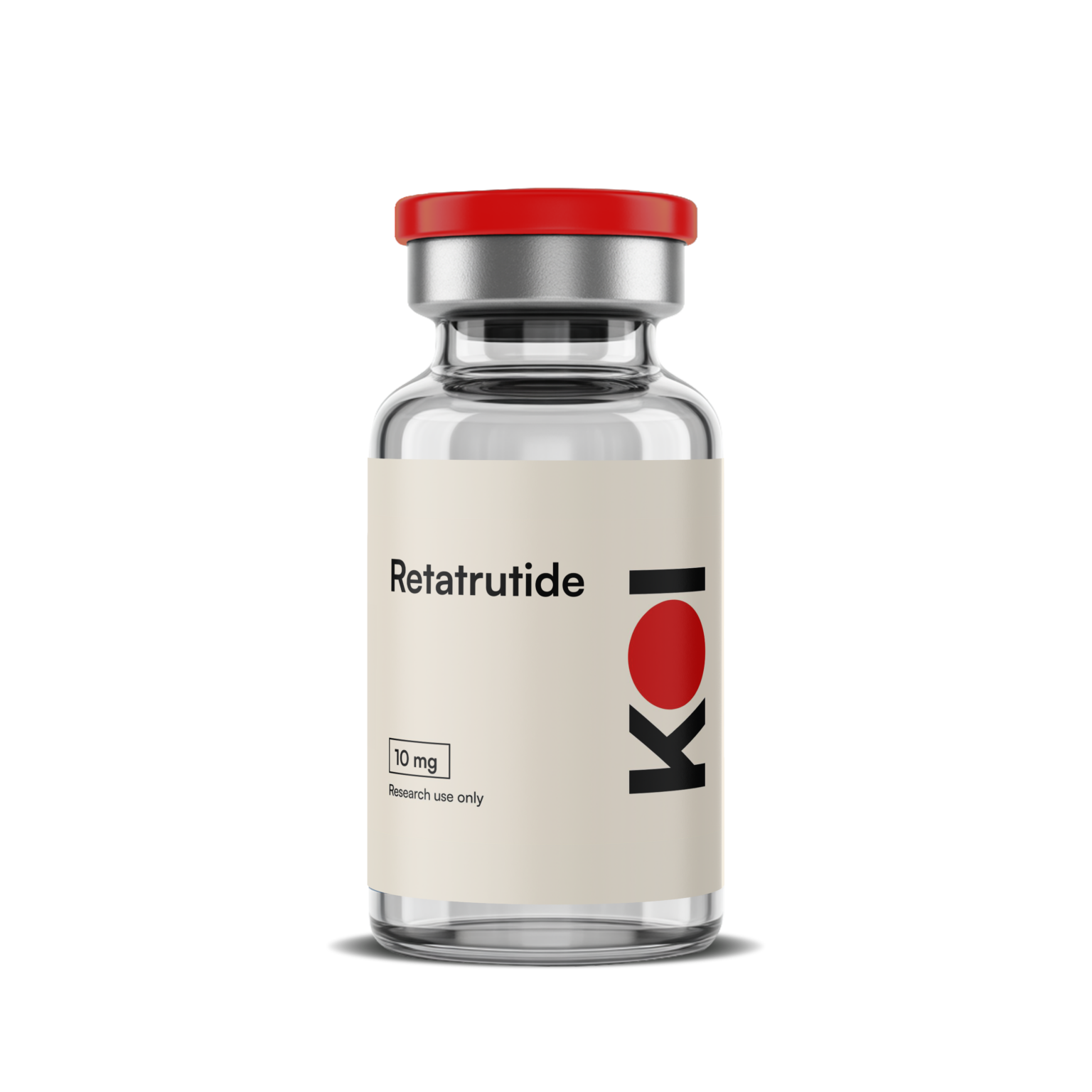
What is GLP-3 (Reta)?
GLP-3 (Reta) (development code LY3437943) is a synthetic single-molecule “triple agonist” that activates three metabolic hormone receptors at once — the GIP receptor, the GLP-1 receptor, and the glucagon receptor. Engaging all three pathways simultaneously drives glucose-dependent insulin secretion through the two incretin arms while adding glucagon-receptor agonism implicated in energy expenditure, the pharmacological rationale that distinguishes it from single (GLP-1 (Sema)) and dual (GLP-2 (Triz)) incretin agonists.
Research areas where laboratories buy GLP-3 (Reta) for in vitro work include triple-receptor binding and cAMP-signaling assays in cells co-expressing GIP, GLP-1 and glucagon receptors, glucose-dependent insulin-secretion studies in pancreatic beta-cell models, energy-expenditure and metabolic-flux research in rodent systems, and comparative dual- versus triple-agonist pharmacology. GLP-3 (Reta) is an investigational compound developed by Eli Lilly and remains in clinical development; it is not an approved medicine.
Compound information
Chemical & structural reference data — specifications, molecular profile and handling.
Product Specifications
Molecular Profile
Storage & Handling
GLP-3 (Reta) Mechanism of Action
- Acts as an agonist at three receptors — the GIP receptor, the GLP-1 receptor, and the glucagon receptor — the defining “triple agonist” pharmacology that separates it from single- and dual-incretin compounds.
- Engages Gαs / adenylyl-cyclase / cAMP signaling at each of the three receptors in receptor-expressing cell models.
- Potentiates glucose-dependent insulin secretion through the GIP and GLP-1 incretin arms in pancreatic beta-cell assays.
- Adds glucagon-receptor agonism on top of the dual-incretin mechanism, a contribution implicated in energy-expenditure and lipid-metabolism pathways in preclinical models.
- Carries a fatty-acid acylation that enables reversible serum-albumin binding and a markedly extended half-life relative to native incretin peptides.
- Serves as the reference triple-receptor tool compound for dissecting the relative contribution of GIP, GLP-1 and glucagon signaling in multi-incretin pharmacology.
GLP-3 (Reta) Research Applications
- GIP, GLP-1 and glucagon receptor binding and cAMP-accumulation assays in cells co-expressing the three receptors, where GLP-3 (Reta) is the standard reference triple agonist.
- Glucose-dependent insulin-secretion studies in pancreatic beta-cell models, isolating the incretin contribution to insulinotropic activity.
- Energy-expenditure and metabolic-flux research in rodent systems, probing the glucagon-receptor arm absent from single- and dual-agonist compounds.
- Comparative dual- versus triple-agonist pharmacology, run alongside GLP-1 (Sema) (single) and GLP-2 (Triz) (dual) to dissect receptor-specific effects.
- Albumin-binding and half-life characterization of fatty-acylated incretin analogs.
- Structure-activity studies of triple-receptor incretin peptides and engineered receptor selectivity.
Why Buy GLP-3 (Reta) from Koi Peptides?
- Every batch of Koi GLP-3 (Reta) is synthesized and lyophilized in the United States, then released against independent third-party laboratory (Freedom Diagnostics Testing) testing.
- Each lot is tested by HPLC for purity, LC-MS for identity confirmation, and endotoxin assay for sterility readiness.
- The lot ID is printed on every vial and ties back to a public COA library, so researchers can verify documentation before they buy and after the vial arrives.
- Orders placed before 2 PM CT ship the same business day, and shipping is free on orders over $200.
References
- Jastreboff, A. M., et al. (2023). Triple–hormone-receptor agonist GLP-3 (Reta) for obesity — a phase 2 trial. New England Journal of Medicine, 389(6), 514–526. doi.org/10.1056/NEJMoa2301972
- Coskun, T., et al. (2022). LY3437943, a novel triple glucagon, GIP, and GLP-1 receptor agonist. Cell Metabolism, 34(9), 1234–1247. doi.org/10.1016/j.cmet.2022.07.013
- Müller, T. D., et al. (2019). Glucagon-like peptide 1 (GLP-1). Molecular Metabolism, 30, 72–130. doi.org/10.1016/j.molmet.2019.09.010
- Rosenstock, J., et al. (2023). GLP-3 (Reta) in people with type 2 diabetes: a phase 2 trial. The Lancet, 402(10401), 529–544. doi.org/10.1016/S0140-6736(23)01053-X
- Knerr, P. J., et al. (2022). Selection and progression of unimolecular agonists at the GIP, GLP-1, and glucagon receptors. Molecular Metabolism, 63, 101533. doi.org/10.1016/j.molmet.2022.101533
- Drucker, D. J. (2018). Mechanisms of action and therapeutic application of GLP-1. Cell Metabolism, 27(4), 740–756. doi.org/10.1016/j.cmet.2018.03.001

GLP 3 (Reta) 60mg 

Reviews
There are no reviews yet.