
Subtotal: $120.00
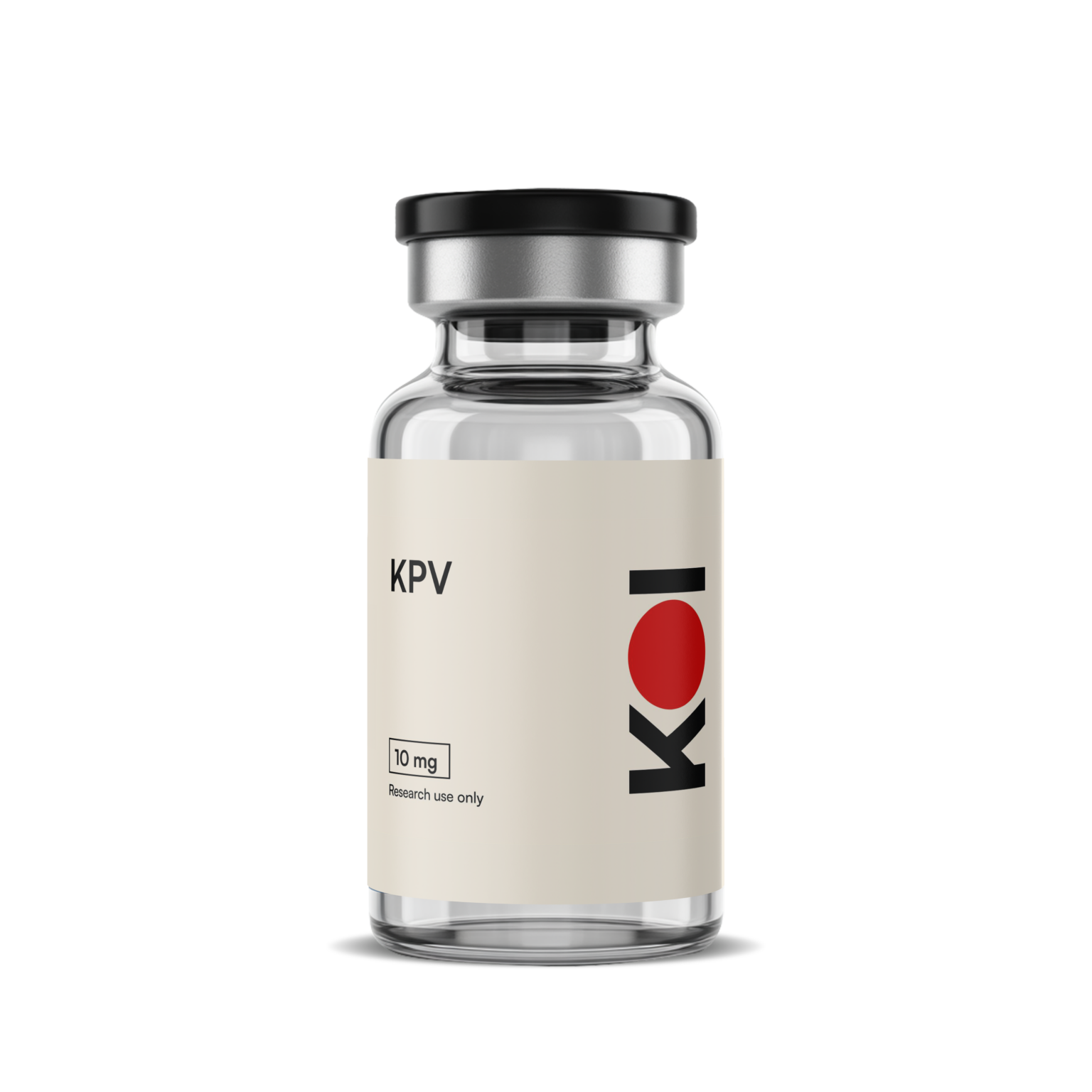
KPV 10mg & 5mg (5mg Vial)
$30.00
A three-amino-acid tripeptide derived from α-melanocyte-stimulating hormone, supplied as 10 mg of sterile lyophilized powder for in-vitro inflammation research.
In stock
Tested by Freedom Diagnostics TestingHPLC purity + LC-MS identityLot-matched COA on-site
For research use only. This product is a laboratory research chemical. It is not for human or veterinary use, not a drug, supplement, or food, and not intended to diagnose, treat, cure, or prevent any disease. Sold only to qualified researchers and institutions.
What is KPV?
KPV is a linear tripeptide composed of lysine, proline, and valine (Lys-Pro-Val) — the three C-terminal residues (positions 11–13) of the 13-amino-acid hormone α-melanocyte-stimulating hormone (α-MSH). Unlike the parent hormone, KPV does not engage the melanocortin receptors (MC1R–MC5R), producing no pigmentation or appetite effect, yet it retains anti-inflammatory activity through a receptor-independent mechanism. This separation of activities is what makes it a useful tool compound for dissecting receptor-dependent from receptor-independent α-MSH biology.
Research areas where laboratories buy KPV for in vitro work include NF-κB pathway-inhibition studies in colonic epithelial cell lines, PepT1 oligopeptide-transporter uptake research, MAPK signaling-suppression assays, and murine colitis models (DSS, TNBS) for damage scoring and cytokine quantification. The peptide is also studied for its antimicrobial activity against Candida albicans and Staphylococcus aureus, retained from the parent α-MSH sequence.
Every lot, independently verified
Independently third-party tested and matched to the lot ID printed on your vial. Values below are from the latest released lot.
99.90%
HPLC-UV Purity
Passed full QC panel
independent third-party lab (Freedom Diagnostics Testing) accredited lab
Latest batch · tested 10 Feb 2026 · Freedom Diagnostics (USA)
Lot details
ProductKPV 10 mg
LotPer-batch on COA
AppearanceWhite lyophilized powder
Accession #2602060018
Reported10 Feb 2026
Full QC panel · ISO 170257 assays
Purity (HPLC-UV)99.899% ✓
Identity (LC-MS)KPV ✓
HPLC conformity (2×)Confirmed ✓
Net content10.83 mg ✓
Heavy metals (ICP-MS)Not Detected ✓
SterilityNo Growth ✓
Endotoxin (USP <85>)Within limits ✓
Compound information
Chemical & structural reference data — specifications, molecular profile and handling.
Product Specifications
CompoundKPV (Lys-Pro-Val tripeptide, C-terminal α-MSH fragment)
Vial size10 mg
Purity≥99% by HPLC
Identity confirmationMass spectrometry
FormWhite lyophilized powder
Appearance after reconstitutionClear, colorless solution
ManufacturingSynthesized and lyophilized in the United States
Quality testingIndependent independent third-party laboratory release
Molecular Profile
SequenceLys-Pro-Val (H-Lys-Pro-Val-OH)
Molecular formulaC16H30N4O4
Molecular weight342.43 g/mol
CAS number67727-97-3
PubChem CID125672
Other namesα-MSH (11-13) · MSH (11-13)
Structure classLinear tripeptide · C-terminal α-MSH fragment
Storage & Handling
AppearanceWhite lyophilized powder
SolubilitySterile water · neutral pH
Storage · powder−20 °C, desiccated, dark (−80 °C long-term)
In solution2–8 °C; aliquot & freeze, avoid freeze-thaw
KPV Mechanism of Action
- Enters cells via PepT1, the proton-coupled di-/tripeptide transporter (reported Km ~160 µM in Caco-2 cells); PepT1 is upregulated in inflamed tissue, amplifying KPV uptake at inflammation sites.
- Competitively disrupts the p65/importin-α3 interaction in the cytoplasm, blocking nuclear translocation of NF-κB in cells exposed to IL-1β or TNF-α.
- Suppresses MAPK signaling at nanomolar concentrations, reducing ERK1/2, JNK, and p38 phosphorylation in stimulated intestinal epithelial cells.
- Operates independently of melanocortin receptors — does not bind MC1R–MC5R, producing no pigmentation or appetite effect.
- Retains the antimicrobial activity of α-MSH against Candida albicans and Staphylococcus aureus in published in-vitro assays.
- Reduces histological damage, cytokine expression, and leukocyte infiltration in DSS and TNBS murine colitis models via the receptor-independent mechanism.
KPV Research Applications
- NF-κB pathway-inhibition studies in colonic epithelial cells (Caco-2, HT29) under inflammatory stimulation.
- PepT1 oligopeptide-transporter research — high-affinity uptake via the proton-coupled transporter upregulated in inflamed tissue.
- MAPK signaling-suppression assays measuring ERK1/2, JNK, and p38 phosphorylation in IL-1β / TNF-α-stimulated cells.
- Murine colitis models (DSS, TNBS) — histological damage scores, cytokine expression, and leukocyte infiltration.
- Antimicrobial-activity studies against Candida albicans, Staphylococcus aureus, and other pathogens.
- Comparative work against the stereoisomer Lys-D-Pro-Val and the related tripeptide K(D)PT to map NF-κB inhibition determinants.
Why Buy KPV from Koi Peptides?
- Every batch of Koi KPV is synthesized and lyophilized in the United States, then released against independent third-party laboratory (Freedom Diagnostics Testing) testing.
- Each lot is tested by HPLC for purity, LC-MS for identity confirmation, and endotoxin assay for sterility readiness.
- The lot ID is printed on every vial and ties back to a public COA library, so researchers can verify documentation before they buy and after the vial arrives.
- Orders placed before 2 PM CT ship the same business day, and shipping is free on orders over $200.
References
The laboratory and preclinical research behind KPV — cited for scientific context.View all 8 references+
- Dalmasso, G., et al. (2008). PepT1-mediated tripeptide KPV uptake reduces intestinal inflammation. Gastroenterology, 134(1), 166–178. doi.org/10.1053/j.gastro.2007.10.026
- Kannengiesser, K., et al. (2008). Melanocortin-derived tripeptide KPV has anti-inflammatory potential. Inflammatory Bowel Diseases, 14(3), 324–331. doi.org/10.1002/ibd.20334
- Brzoska, T., et al. (2008). α-MSH and related tripeptides: anti-inflammatory and protective effects. Endocrine Reviews, 29(5), 581–602. doi.org/10.1210/er.2007-0027
- Catania, A., et al. (2004). Targeting melanocortin receptors as a strategy to control inflammation. Pharmacological Reviews, 56(1), 1–29. doi.org/10.1124/pr.56.1.1
- Cutuli, M., et al. (2000). Antimicrobial effects of α-MSH peptides. J. Leukocyte Biology, 67(2), 233–239. doi.org/10.1002/jlb.67.2.233
- Xiao, B., et al. (2017). Orally targeted delivery of tripeptide KPV alleviates ulcerative colitis. Molecular Therapy, 25(7), 1628–1640. doi.org/10.1016/j.ymthe.2016.11.020
- Mandrika, I., et al. (2001). Melanocortin peptides on NF-κB DNA binding and NO production in macrophages. Biochemical Pharmacology, 61(5), 613–621. doi.org/10.1016/S0006-2952(00)00583-7
- Bettenworth, D., et al. (2011). The tripeptide KdPT protects from intestinal inflammation. American Journal of Pathology, 179(3), 1230–1242. doi.org/10.1016/j.ajpath.2011.05.013
Regulatory Status
FDA, WADA anti-doping, and compounding status — provided for research context.FDA StatusKPV is not approved by the FDA for any indication. It is an unapproved research compound and has not been evaluated by the FDA for safety or efficacy. The research-grade material supplied by Koi Peptides is synthesized for in vitro laboratory research only — not formulated, packaged, or labeled for human use, and not authorized for any human or veterinary indication.WADA Anti-Doping StatusKPV is not currently named on the WADA Prohibited List. Researchers should consult the current WADA List directly, as classifications are reviewed annually. This information is provided for research context only and does not constitute compliance advice.Compounding Pharmacy StatusKoi Peptides is a chemical research supplier — not a compounding pharmacy or outsourcing facility under sections 503A or 503B of the Federal Food, Drug, and Cosmetic Act — and supplies no compounded preparations of any kind. As an unapproved research compound, KPV is not eligible for pharmacy compounding for human use.DisclaimerFor research use only. Not for human or veterinary use. KPV is supplied to qualified research professionals for in vitro laboratory study. It has not been evaluated by the FDA and is not intended to diagnose, treat, cure, or prevent any disease. Koi Research Labs LLC is a chemical supplier, not a compounding pharmacy under 503A nor an outsourcing facility under 503B of the Federal Food, Drug, and Cosmetic Act. By purchasing, the buyer agrees this material will not be introduced into humans or animals. Misuse may violate federal, state, or local laws.
Be the first to review “KPV 10mg & 5mg (5mg Vial)”
Related products
Reviews
There are no reviews yet.