
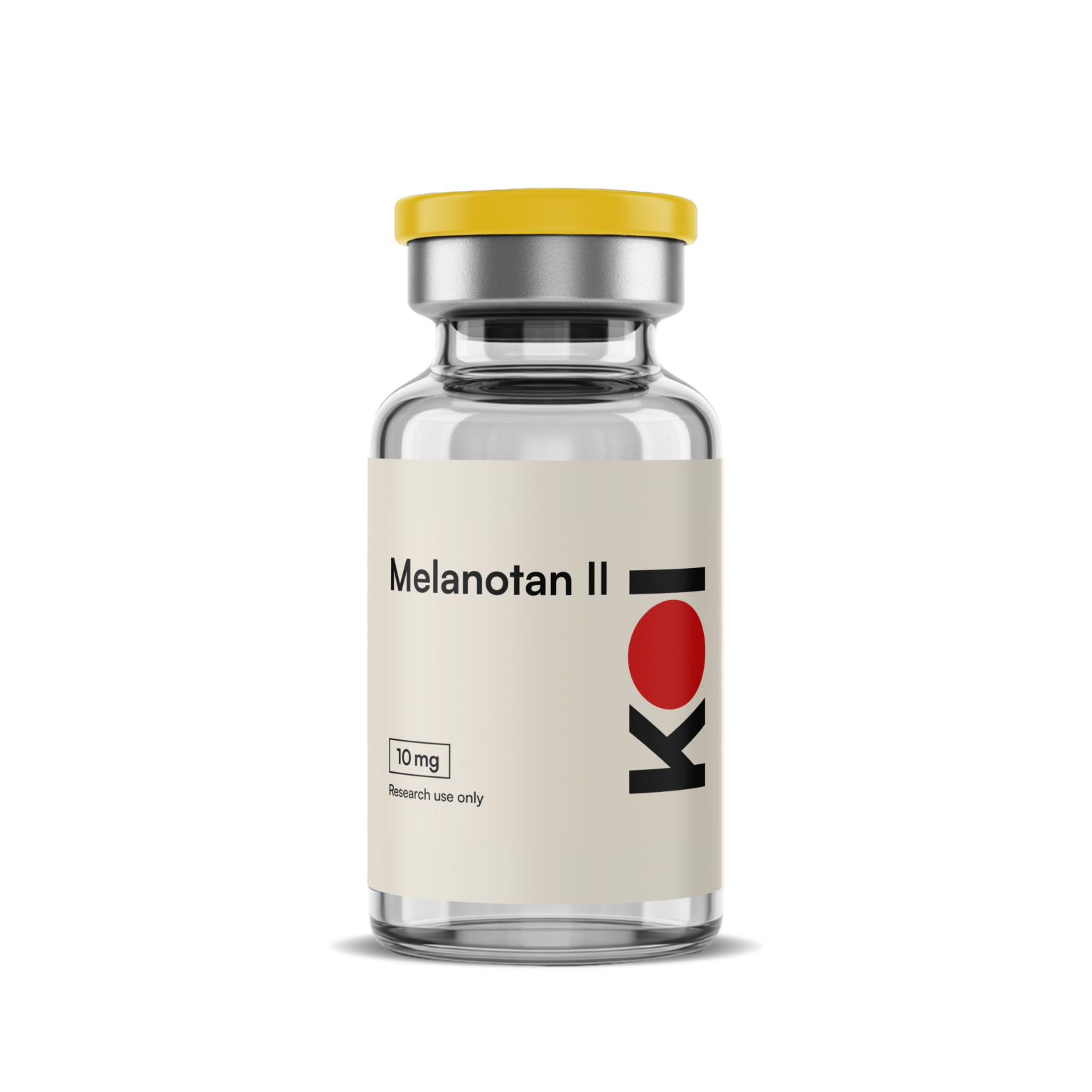
Melanotan-II 10mg
$55.00
A cyclic heptapeptide α-MSH analog and non-selective melanocortin (MC1R–MC5R) agonist, supplied as 10 mg freeze-dried powder for in-vitro melanocortin-pathway research.
Tested by Freedom Diagnostics TestingHPLC purity + LC-MS identityLot-matched COA on-site
For research use only. This product is a laboratory research chemical. It is not for human or veterinary use, not a drug, supplement, or food, and not intended to diagnose, treat, cure, or prevent any disease. Sold only to qualified researchers and institutions.
What is Melanotan-II?
Melanotan-II is a man-made peptide of seven amino acids, joined into a ring. It copies α-MSH, a natural hormone that signals skin cells to make pigment. Researchers at the University of Arizona, led by Victor Hruby and Mac Hadley, built it in the late 1980s as a sturdier, stronger version of that hormone, first to study tanning without sun exposure. The ring shape comes from a lactam bridge, an internal link that makes the peptide more compact and harder for enzymes to break down.
Labs use Melanotan-II mainly to study the melanocortin system, a group of receptors that affect skin color, appetite, and sexual function. Because it switches on all four of these receptors instead of just one, it works as a common reference compound for receptor and signaling experiments. Researchers also use it in pigmentation and UV-protection models, in studies of the brain pathways behind arousal and feeding, and in work that compares its ring structure with the natural hormone. The material supplied here is research-grade for in vitro laboratory study only.
Every lot, independently verified
Compound information
Chemical & structural reference data — specifications, molecular profile and handling.
Melanotan-II Mechanism of Action
- Mimics α-MSH and turns on all four melanocortin receptors (MC1R, MC3R, MC4R, and MC5R) — a wider reach than the natural hormone or the MC1R-only analog afamelanotide.
- At MC1R on pigment cells, it raises cAMP and shifts the switch from red-yellow pigment to brown-black eumelanin, the change behind skin darkening.
- At MC4R in the brain, it acts on the circuits for arousal and appetite, the basis for the early human findings on erection and reduced hunger.
- Also engages MC3R (energy balance and feeding) and MC5R (gland function), giving it the broadest receptor reach of the melanotan compounds.
- A lactam ring plus two amino-acid swaps help it resist breakdown and stay active far longer than α-MSH — a preclinical half-life near 33 minutes versus under 5 minutes for the natural hormone.
- In a placebo-controlled study of men with erectile dysfunction, it produced erections in 12 of 19 doses versus 1 of 21 for placebo, confirming the central MC4R effect.
Melanotan-II Research Applications
- Melanocortin receptor pharmacology — a standard non-selective tool for studying MC1R, MC3R, MC4R, and MC5R in cAMP and receptor-binding assays.
- Pigmentation research testing how MC1R activation drives eumelanin production in melanocyte and skin-cell models.
- Photoprotection research asking whether increased melanin can shield skin from UV damage — the original aim behind the compound.
- Sexual-function research probing the brain MC4R pathways behind arousal and erection, the line of work that led to the approved drug bremelanotide.
- Appetite and energy-balance research on how MC4R and MC3R signaling shapes feeding and body weight in animal models.
- Peptide-engineering research comparing its cyclic, stabilized structure with α-MSH and linear analogs to see how the ring affects potency and receptor selectivity.
Why Buy Melanotan-II from Koi Peptides?
- Every batch of Koi Melanotan-II is made and freeze-dried inside the United States, then released against independent third-party laboratory (Freedom Diagnostics Testing) testing.
- Each lot is checked for purity by HPLC, verified for structure by mass spectrometry, and screened for endotoxin before it goes on sale.
- The lot ID is printed on every vial and ties back to a public COA library, so researchers can verify documentation before they buy and after the vial arrives.
- Orders placed before 2 PM CT ship the same business day, and shipping is free on orders over $200.
- Sawyer, T.K., Sanfilippo, P.J., Hruby, V.J., et al. (1980). 4-Norleucine, 7-D-phenylalanine-α-melanocyte-stimulating hormone: a highly potent α-melanotropin with ultralong biological activity. PNAS, 77(10), 5754–5758. doi.org/10.1073/pnas.77.10.5754
- Cai, M., & Hruby, V.J. (2016). The melanocortin receptor system: a target for multiple degenerative diseases. Current Protein and Peptide Science, 17(5), 488–496.
- Mun, Y., Kim, W., & Shin, D. (2023). Melanocortin 1 receptor (MC1R): pharmacological and therapeutic aspects. International Journal of Molecular Sciences, 24(15), 12152. doi.org/10.3390/ijms241512152
- Wessells, H., Levine, N., Hadley, M.E., Dorr, R., & Hruby, V.J. (2000). Melanocortin receptor agonists, penile erection, and sexual motivation: human studies with Melanotan II. International Journal of Impotence Research, 12(Suppl 4), S74–S79. doi.org/10.1038/sj.ijir.3900582
- Wessells, H., Gralnek, D., Dorr, R., et al. (2000). Effect of an alpha-melanocyte stimulating hormone analog on penile erection and sexual desire in men with organic erectile dysfunction. Urology, 56(4), 641–646.
- Cone, R.D. (2006). Studies on the physiological functions of the melanocortin system. Endocrine Reviews, 27(7), 736–749.
- Hadley, M.E., & Dorr, R.T. (2006). Melanocortin peptide therapeutics: historical milestones, clinical studies and commercialization. Peptides, 27(4), 921–930.
- Dorr, R.T., Lines, R., Levine, N., et al. (1996). Evaluation of melanotan-II, a superpotent cyclic melanotropic peptide in a pilot phase-I clinical study. Life Sciences, 58(20), 1777–1784. doi.org/10.1016/0024-3205(96)00160-9
Regulatory Status
For research use only. Not for human or veterinary use. Melanotan-II is supplied to qualified research professionals for in vitro laboratory study. It has not been evaluated by the FDA and is not intended to diagnose, treat, cure, or prevent any disease. Koi Research Labs LLC is a chemical supplier, not a compounding pharmacy under 503A nor an outsourcing facility under 503B of the Federal Food, Drug, and Cosmetic Act. By purchasing, the buyer agrees this material will not be introduced into humans or animals. Misuse may violate federal, state, or local laws.
Be the first to review “Melanotan-II 10mg”
Related products
Reviews
There are no reviews yet.