
Subtotal: $15.00
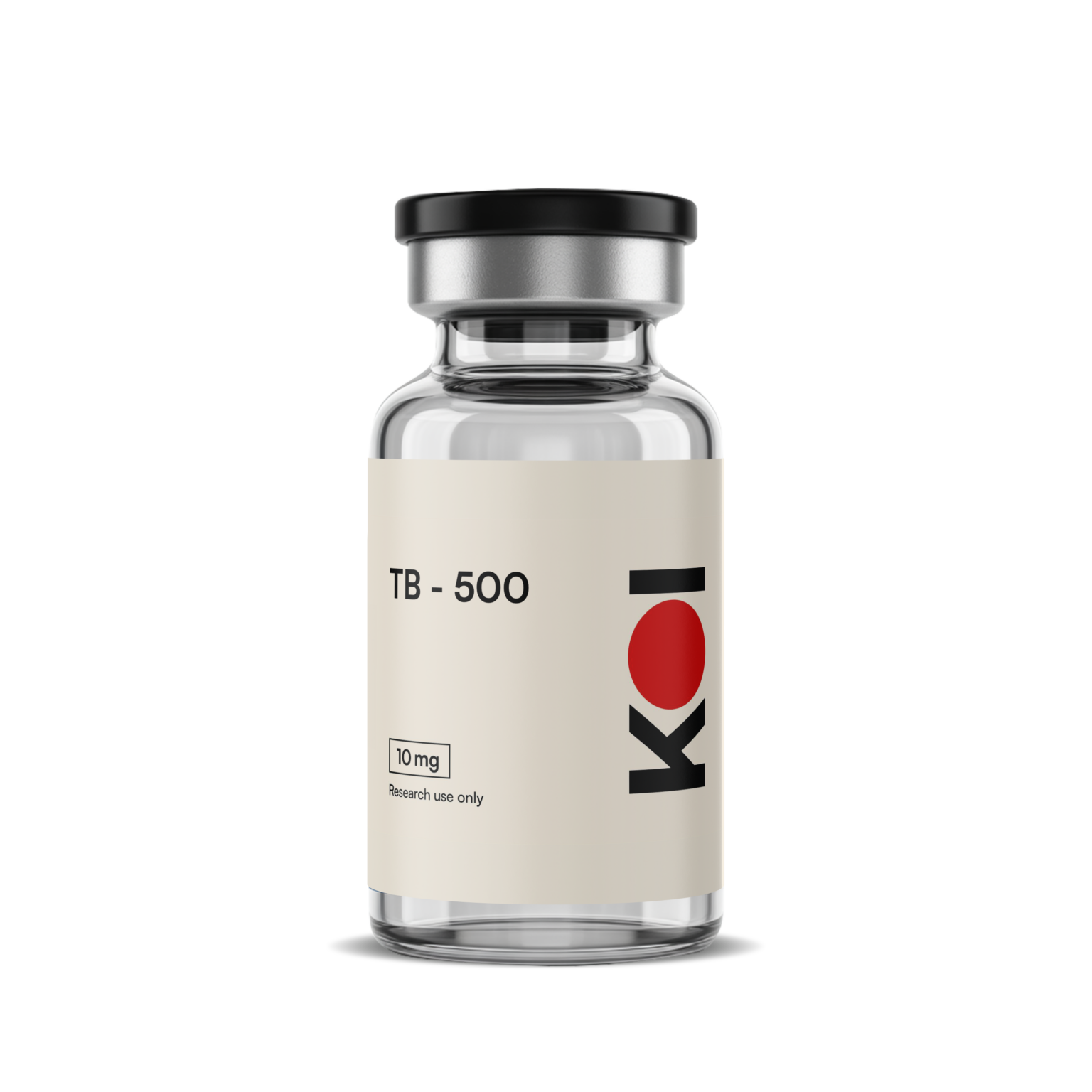
TB-500 (Thymosin Beta-4) 10mg
$54.00
A 43-amino-acid acetylated synthetic Thymosin Beta-4, supplied lyophilized for in vitro actin-binding and tissue-repair research.
Tested by Freedom Diagnostics TestingHPLC purity + LC-MS identityLot-matched COA on-site
For research use only. This product is a laboratory research chemical. It is not for human or veterinary use, not a drug, supplement, or food, and not intended to diagnose, treat, cure, or prevent any disease. Sold only to qualified researchers and institutions.
What is TB-500?
TB-500 is a synthetic 43-amino-acid acetylated peptide corresponding to thymosin β-4 (Tβ4), a naturally occurring actin-sequestering protein. It binds monomeric G-actin through the central LKKTETQ motif, regulating the cytoplasmic actin pool available for filament elongation, and is studied for its role in cell migration, angiogenesis, and tissue-repair signaling. Its low molecular weight, absence of disulfide bonds, and lack of extracellular-matrix binding let it cross tissue compartments readily in research models.
Research areas where laboratories buy TB-500 for in vitro work include actin pharmacology separating Tβ4 effects from those of its Ac-SDKP cleavage fragment, migration and wound-closure assays in dermal fibroblasts, keratinocytes and corneal epithelial cells, angiogenesis readouts in HUVEC tube-formation and aortic-ring models, cardiac and skeletal-muscle repair models in rodents, and cytoskeletal imaging with fluorescent G-actin and F-actin reporters. TB-500 / thymosin β-4 is not an approved medicine.
Every lot, independently verified
Independently third-party tested and matched to the lot ID printed on your vial. Values below are from the latest released lot.
Lot details
ProductTB-500 10 mg
COA ref #2512290134
AppearanceWhite lyophilized powder
Received29 Dec 2025
Reported30 Dec 2025
Full QC panel · ISO 170257 assays
Purity (HPLC-UV)99.127% ✓
Identity (LC-MS)Thymosin Beta-4 ✓
HPLC conformity (2×)Confirmed ✓
Net content (10 mg label)9.97 mg ✓
Heavy metals (ICP-MS)Not Detected ✓
SterilityNo Growth ✓
Endotoxin (USP <85>)Within limits ✓
Storage & Handling
Compound information
Chemical & structural reference data — specifications, molecular profile and handling.
Product Specifications
CompoundTB-500 (synthetic thymosin β-4; 43-aa acetylated peptide)
Vial size10 mg
Purity≥99% by HPLC
Identity confirmationMass spectrometry
FormLyophilized white powder
Appearance after reconstitutionClear, colorless solution
ManufacturingSynthesized and lyophilized in the United States
Quality testingIndependent independent third-party laboratory release
Molecular Profile
Type43-aa acetylated β-thymosin
SequenceAc-SDKPDMAEIEKFDKSKLKKTETQEKNPLPSKETIEQEKQAGES
Molecular formulaC212H350N56O78S
Molecular weight4963.44 g/mol
CAS number77591-33-4
PubChem CID16132341
StructureSingle Met (pos 6); no disulfides
Storage & Handling
AppearanceLyophilized white powder
SolubilityFreely water-soluble
Storage · powder−20 °C, desiccated, dark (−80 °C long-term)
In solution2–8 °C; aliquot & freeze, avoid freeze-thaw
TB-500 Mechanism of Action
- Binds monomeric G-actin through the central LKKTETQ motif, sequestering actin monomers and modulating the cytoplasmic pool available for filament elongation.
- Promotes endothelial migration, tube formation, and vessel-network density in HUVEC tube-formation and aortic-ring angiogenesis models.
- Engages the N-terminal Ac-SDKP cleavage pathway, where prolyl oligopeptidase liberates the tetrapeptide that carries its own hematopoiesis and fibrosis activity.
- Crosses tissue compartments readily — low molecular weight, no disulfide bonds, no extracellular-matrix binding.
- Influences epicardial progenitor activation and fibrosis-marker expression in rodent cardiac ischemia-reperfusion and crush-injury models.
TB-500 Research Applications
- Actin pharmacology — separating Tβ4 effects dependent on the LKKTETQ motif from those of the Ac-SDKP tetrapeptide.
- Migration and wound-closure assays in dermal fibroblasts, keratinocytes, and corneal epithelial cells.
- Angiogenesis readouts in HUVEC tube-formation and aortic-ring models.
- Cardiac & skeletal-muscle repair models in rodents — ischemia-reperfusion and crush-injury designs.
- Cytoskeletal imaging with fluorescent G-actin and F-actin reporters tracking the polymerization equilibrium.
Why Buy TB-500 from Koi Peptides?
- Every batch of Koi TB-500 is synthesized and lyophilized in the United States, then released against independent third-party laboratory (Freedom Diagnostics Testing) testing.
- Each lot is tested by HPLC for purity, LC-MS for identity confirmation, and endotoxin assay for sterility readiness.
- The lot ID is printed on every vial and ties back to a public COA library, so researchers can verify documentation before they buy and after the vial arrives.
- Orders placed before 2 PM CT ship the same business day, and shipping is free on orders over $200.
- Goldstein, A. L., et al. (2005). Thymosin β4: actin-sequestering protein moonlights to repair injured tissues. Trends in Molecular Medicine, 11(9), 421–429. doi.org/10.1016/j.molmed.2005.07.004
- Safer, D., et al. (1991). Thymosin β4 and Fx, an actin-sequestering peptide, are indistinguishable. Journal of Biological Chemistry, 266(7), 4029–4032.
- Crockford, D., et al. (2010). Thymosin β4: structure, function, and biological properties. Annals of the New York Academy of Sciences, 1194, 179–189. doi.org/10.1111/j.1749-6632.2010.05492.x
- Malinda, K. M., et al. (1997). Thymosin β4 stimulates directional migration of human umbilical vein endothelial cells. FASEB Journal, 11(6), 474–481. doi.org/10.1096/fasebj.11.6.9194528
- Bock-Marquette, I., et al. (2004). Thymosin β4 activates integrin-linked kinase and promotes cardiac cell migration, survival and repair. Nature, 432(7016), 466–472. doi.org/10.1038/nature03000
- Smart, N., et al. (2007). Thymosin β4 induces adult epicardial progenitor mobilization and neovascularization. Nature, 445(7124), 177–182. doi.org/10.1038/nature05383
- Xue, B., & Robinson, R. C. (2013). Guardians of the actin monomer. European Journal of Cell Biology, 92(10–11), 316–332. doi.org/10.1016/j.ejcb.2013.10.012
- Cavasin, M. A., et al. (2004). Prolyl oligopeptidase is involved in release of the antifibrotic peptide Ac-SDKP. Hypertension, 43(5), 1140–1145. doi.org/10.1161/01.HYP.0000126172.01673.84
- Liu, J. M., et al. (2003). Ac-SDKP is generated from thymosin β4 in vivo by ACE N domain. Journal of Biological Chemistry, 278(40), 38513–38520. doi.org/10.1074/jbc.M209853200
- Sosne, G., et al. (2010). Biological activities of thymosin β4 defined by active sites in short peptide sequences. FASEB Journal, 24(7), 2144–2151. doi.org/10.1096/fj.09-142307
Be the first to review “TB-500 (Thymosin Beta-4) 10mg”
Related products
Reviews
There are no reviews yet.