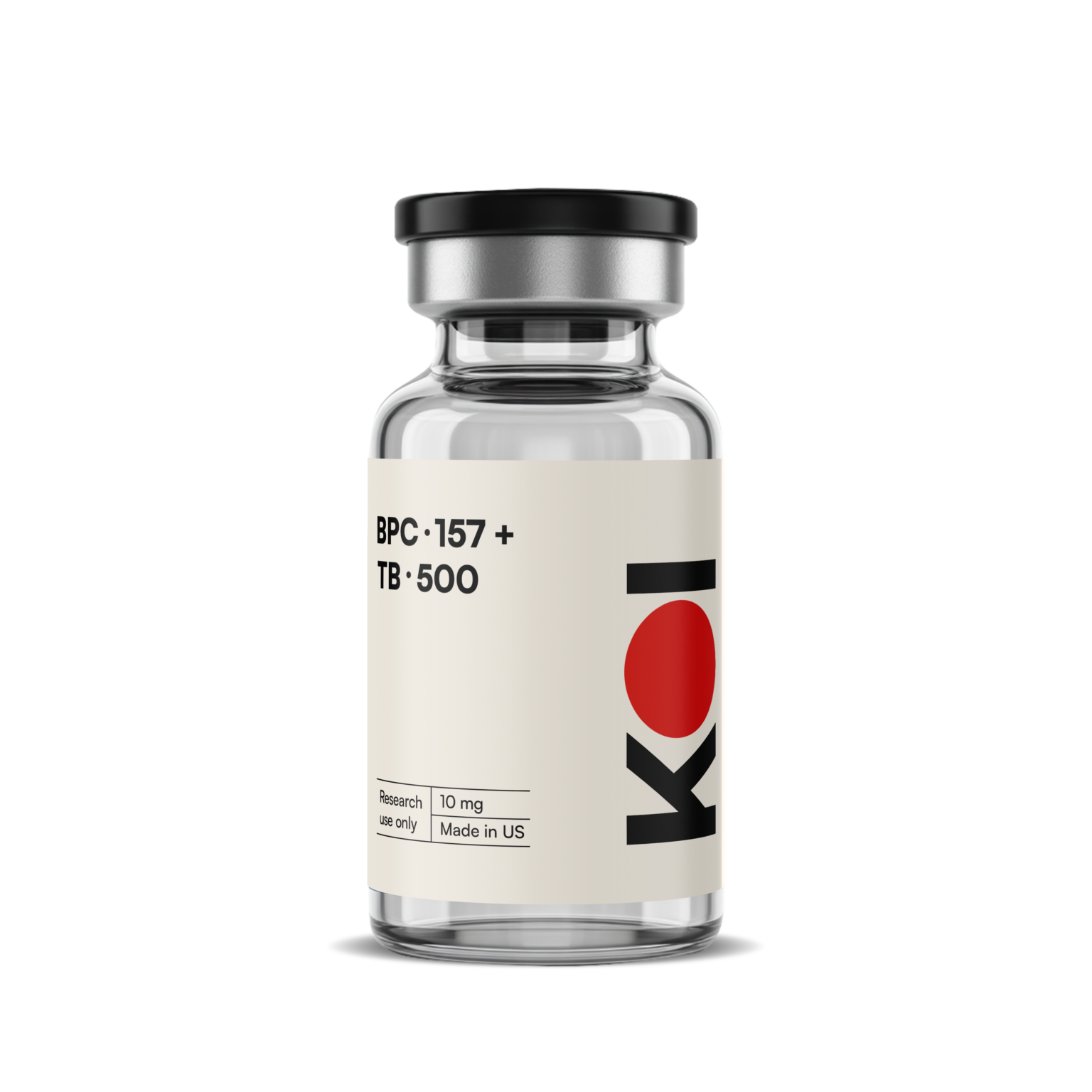
What is the Wolverine Blend?
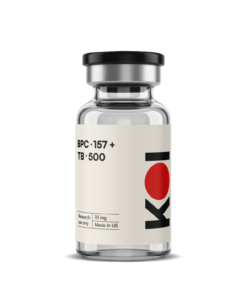
The Wolverine Blend is a single-vial, two-peptide regenerative combination that pairs BPC-157 (5 mg) with TB-500 (5 mg) in one co-lyophilized sterile cake. The two peptides act on non-overlapping points of the tissue-repair cascade: BPC-157 drives angiogenic and growth-factor signaling, including VEGF/VEGFR2 engagement and nitric-oxide pathway modulation, while TB-500 (thymosin β-4) sequesters monomeric G-actin to modulate cytoskeletal remodeling and cell migration. Combining them in one preparation is what makes the blend a convenient reference system for in vitro work that needs both activities in a single run.
Research areas where laboratories buy the Wolverine Blend for in vitro work include comparative study of how angiogenic signaling (BPC-157-led) and actin-driven cell migration (TB-500-led) interact during tissue repair, VEGF/VEGFR2 and FAK-paxillin pathway activity in cell-culture models of tendon, ligament and muscle repair, thymosin-β-4-dependent actin polymerization and cytoskeletal remodeling in wound-healing assays, and preclinical evaluation in rodent models of soft-tissue, musculoskeletal, and gastrointestinal-mucosal repair.
Every lot, independently verified
Compound information
Chemical & structural reference data — specifications, molecular profile and handling.
Wolverine Blend Mechanism of Action
- BPC-157 drives angiogenic and growth-factor signaling, including VEGF/VEGFR2 engagement, FAK-paxillin and Rho-GTPase activation in fibroblast cultures, and nitric-oxide pathway modulation via L-NAME-sensitive, L-arginine-rescuable routes.
- TB-500 binds monomeric G-actin through the central LKKTETQ motif, sequestering actin monomers and modulating the cytoplasmic pool available for filament elongation in cell-based assays.
- The two mechanisms cover non-overlapping points of the repair cascade — BPC-157 on the signaling and vascular-formation layer, TB-500 on the cytoskeletal-remodeling and cell-migration layer.
- Both peptides show published activity across rodent and cell-culture tissue-repair models without binding a single canonical receptor, distinguishing the blend from receptor-targeted compounds.
- BPC-157’s high proline content and TB-500’s absence of disulfide bonds give the combined formulation robust stability under standard reconstitution and storage.
- In paired designs the two peptides can be applied together or in time-resolved sequence to dissociate angiogenic (BPC-157-led) from cell-migration (TB-500-led) activity in one shared assay.
Wolverine Blend Research Applications
- Comparative study of how angiogenic signaling (BPC-157) and actin-driven cell migration (TB-500) interact during in-vitro tissue repair.
- VEGF/VEGFR2 and FAK-paxillin pathway activity in cell-culture models of tendon, ligament, and muscle repair.
- Thymosin-β-4-dependent actin polymerization and cytoskeletal remodeling in wound-healing assays.
- Preclinical evaluation in rodent models of soft-tissue, musculoskeletal, and gastrointestinal-mucosal repair.
- Nitric-oxide (NO) and eNOS activity in vascular-research models using BPC-157.
- Inflammatory-cytokine modulation in cell-based models of repair under defined conditions.
Why Buy the Wolverine Blend from Koi Peptides?
- Every batch of the Koi Wolverine Blend is synthesized and lyophilized in the United States, then released against independent third-party laboratory (Freedom Diagnostics Testing) testing.
- Each peptide in the blend is tested separately by HPLC for purity, LC-MS for identity confirmation, and endotoxin assay for sterility readiness.
- The lot ID is printed on every vial and ties back to a public COA library, so researchers can verify documentation before they buy and after the vial arrives.
- Orders placed before 2 PM CT ship the same business day, and shipping is free on orders over $200.
- Sikirić, P., et al. (2018). Stable gastric pentadecapeptide BPC 157 — vascular and organoprotective effects. Current Pharmaceutical Design, 24(18), 1990–2001. doi.org/10.2174/1381612824666180712110447
- Seiwerth, S., et al. (2021). Stable gastric pentadecapeptide BPC 157 and wound healing. Frontiers in Pharmacology, 12, 627533. doi.org/10.3389/fphar.2021.627533
- Hsieh, M. J., et al. (2017). Pro-angiogenic BPC157 associated with VEGFR2 activation and up-regulation. Journal of Molecular Medicine, 95(3), 323–333. doi.org/10.1007/s00109-016-1488-y
- Goldstein, A. L., et al. (2005). Thymosin β4: actin-sequestering protein moonlights to repair injured tissues. Trends in Molecular Medicine, 11(9), 421–429. doi.org/10.1016/j.molmed.2005.07.004
- Crockford, D., et al. (2010). Thymosin β4: structure, function and biological properties. Annals of the NY Academy of Sciences, 1194, 179–189. doi.org/10.1111/j.1749-6632.2010.05492.x
- Bock-Marquette, I., et al. (2004). Thymosin β4 activates ILK and promotes cardiac cell migration, survival and repair. Nature, 432(7016), 466–472. doi.org/10.1038/nature03000
- Smart, N., et al. (2007). Thymosin β4 induces adult epicardial progenitor mobilization and neovascularization. Nature, 445(7124), 177–182. doi.org/10.1038/nature05383
- Chang, C. H., et al. (2014). BPC 157 enhances growth-hormone receptor expression in tendon fibroblasts. Molecules, 19(11), 19066–19077. doi.org/10.3390/molecules191119066
- Vasireddi, N., et al. (2024). Emerging use of BPC-157 in orthopaedic sports medicine: a systematic review. Journal of ISAKOS.
Regulatory Status
FDA, WADA anti-doping, and compounding status — provided for research context.FDA StatusNeither component of the Wolverine Blend is approved by the FDA for any indication. BPC-157 and TB-500 (thymosin β-4) are research compounds with no approved human or veterinary drug product. The research-grade material supplied by Koi Peptides is synthesized for in vitro laboratory research only — not formulated, packaged, or labeled for human use, and not authorized for any human or veterinary indication.WADA Anti-Doping StatusThe TB-500 component — thymosin β-4 — is prohibited at all times under section S2 of the WADA Prohibited List (peptide hormones, growth factors, related substances and mimetics), which expressly names thymosin-β-4 and its derivatives. Athletes subject to anti-doping rules should treat the blend as prohibited on that basis. BPC-157 is not currently named on the Prohibited List but has drawn anti-doping scrutiny; athletes should maintain documentation and seek guidance before use.Compounding Pharmacy StatusKoi Peptides is a chemical research supplier — not a compounding pharmacy or outsourcing facility under sections 503A or 503B of the Federal Food, Drug, and Cosmetic Act — and supplies no compounded preparations of any kind. Because neither component is an approved drug, the blend is not eligible for pharmacy compounding for human use.DisclaimerFor research use only. Not for human or veterinary use. The Wolverine Blend is supplied to qualified research professionals for in vitro laboratory study. It has not been evaluated by the FDA and is not intended to diagnose, treat, cure, or prevent any disease. Koi Research Labs LLC is a chemical supplier, not a compounding pharmacy under 503A nor an outsourcing facility under 503B of the Federal Food, Drug, and Cosmetic Act. By purchasing, the buyer agrees this material will not be introduced into humans or animals. Misuse may violate federal, state, or local laws.
KPV 10mg & 5mg (10mg Vial) 


Reviews
There are no reviews yet.