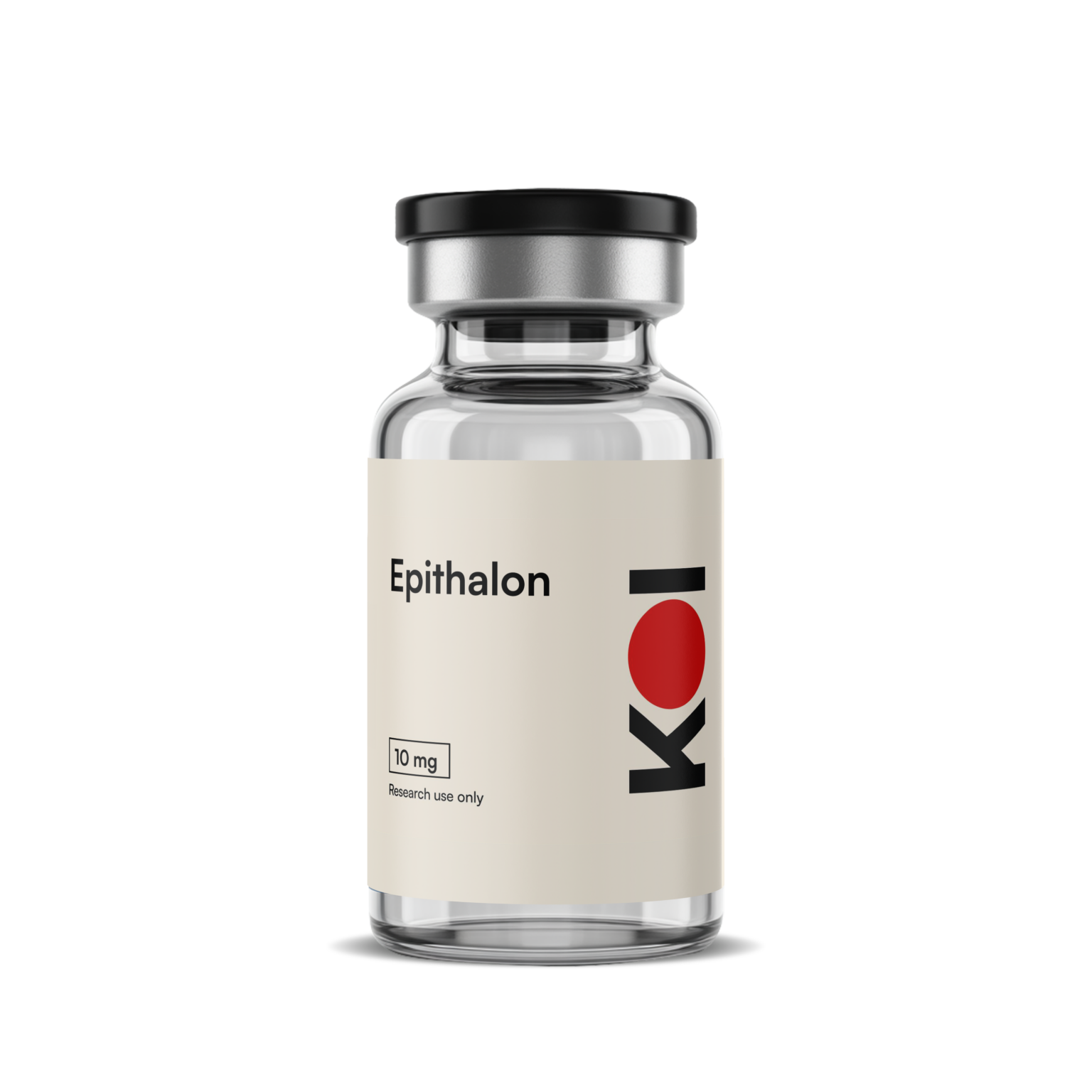
What is Epithalon?
Epithalon is a small synthetic peptide made of four amino acids: alanine, glutamic acid, aspartic acid, and glycine (Ala-Glu-Asp-Gly). Researcher Vladimir Khavinson developed it at the St. Petersburg Institute of Bioregulation and Gerontology as a lab-made version of epithalamin, a natural substance from the pineal gland. With just four amino acids, it is one of the smallest peptides used in this area of research.
Laboratories use epithalon mostly in two areas: how cells age and the pineal gland, which controls the sleep hormone melatonin. In cell studies, researchers look at its effect on telomerase — the enzyme that maintains the protective caps on the ends of chromosomes — and at how long the cells keep dividing. In animal studies, they measure melatonin and circadian rhythms, follow lifespan and tumor rates, and test effects on oxidative stress and DNA stability. The material supplied here is research-grade for in vitro laboratory study only.
Every lot, independently verified
Compound information
Chemical & structural reference data — specifications, molecular profile and handling.
Epithalon Mechanism of Action
- Activates telomerase, the enzyme that maintains the protective caps on the ends of chromosomes, in human cells that normally make very little of it.
- Makes those telomere caps longer and lets cells keep dividing for longer — in one often-cited study, untreated cells stopped dividing after 34 passages while treated cells continued past 44.
- Can bind directly to DNA near the control regions of certain genes, including the telomerase gene, which may change how active those genes are.
- Raises evening melatonin and helps restore the daily melatonin and cortisol rhythm in aged animal models (results vary by species).
- Lowers reactive oxygen species and helps protect DNA from damage in cell and animal tests, acting as an antioxidant.
- Increased both average and maximum lifespan and lowered tumor rates in studies on fruit flies, mice, and rats.
Epithalon Research Applications
- Telomerase research in human cells — measuring telomerase activity and telomere length, including work separating the two main routes of telomere elongation.
- Cell-aging studies watching treated cells divide past their usual replicative limit.
- Pineal-gland and body-clock research measuring evening melatonin and the melatonin/cortisol rhythm in aged animals.
- Aging and lifespan studies in lab animals, tracking lifespan alongside aging markers and tumor counts.
- Oxidative-stress assays examining free-radical levels, mitochondrial health, and DNA stability after exposure.
- Comparative work against other short bioregulator peptides to learn how small sequences bind DNA and affect gene activity.
Why Buy Epithalon from Koi Peptides?
- Every batch of Koi epithalon is produced and freeze-dried domestically in the United States, then released against independent third-party laboratory (Freedom Diagnostics Testing) testing.
- Each lot is tested by HPLC for purity, mass spectrometry for identity, and screened for endotoxin before it reaches the catalog.
- The lot ID is printed on every vial and ties back to a public COA library, so researchers can verify documentation before they buy and after the vial arrives.
- Orders placed before 2 PM CT ship the same business day, and shipping is free on orders over $200.
- Khavinson, V.Kh., Bondarev, I.E., & Butyugov, A.A. (2003). Epithalon peptide induces telomerase activity and telomere elongation in human somatic cells. Bulletin of Experimental Biology and Medicine, 135(6), 590–592. doi.org/10.1023/A:1025493705728
- Khavinson, V.Kh., Bondarev, I.E., Butyugov, A.A., & Smirnova, T.D. (2004). Peptide promotes overcoming of the division limit in human somatic cell. Bulletin of Experimental Biology and Medicine, 137(5), 503–506.
- Khavinson, V.Kh., Shataeva, L.K., & Chernova, A.A. (2005). DNA double-helix binds regulatory peptides similarly to transcription factors. Neuro Endocrinology Letters, 26(3), 237–241.
- Goncharova, N.D., Vengerin, A.A., Khavinson, V.Kh., & Lapin, B.A. (2005). Pineal peptides restore age-related disturbances in hormonal functions of the pineal gland and pancreas. Experimental Gerontology, 40(1–2), 51–57. doi.org/10.1016/j.exger.2004.10.004
- Anisimov, V.N., Khavinson, V.Kh., Popovich, I.G., et al. (2003). Effect of Epitalon on biomarkers of aging, life span and spontaneous tumor incidence in female Swiss-derived SHR mice. Biogerontology, 4(4), 193–202.
- Khavinson, V.Kh., Izmaylov, D.M., Obukhova, L.K., & Malinin, V.V. (2000). Effect of epitalon on the lifespan increase in Drosophila melanogaster. Mechanisms of Ageing and Development, 120(1–3), 141–149.
- Vinogradova, I.A., Bukalev, A.V., Zabezhinski, M.A., et al. (2007). Effect of Ala-Glu-Asp-Gly peptide on life span and spontaneous tumor development in rats under different lighting regimes. Bulletin of Experimental Biology and Medicine, 144(6), 825–830.
- Al-Dulaimi, S., Thomas, R., Matta, S., & Roberts, T. (2025). Epitalon increases telomere length in human cell lines through telomerase upregulation or ALT activity. Biogerontology. doi.org/10.1007/s10522-025-10315-x
Regulatory Status
FDA, WADA anti-doping, and compounding status — provided for research context.FDA StatusEpithalon is not approved by the FDA for any use, and no finished drug product containing it is marketed in the United States. In 2023 the FDA placed epithalon in Category 2 of its review of bulk drug substances for compounding under section 503A — a category for substances judged to lack sufficient evidence of safety and effectiveness. The research-grade material supplied by Koi Peptides is synthesized strictly as a laboratory reagent: not formulated, packaged, or labeled for human use, and not authorized for any human or veterinary indication.WADA Anti-Doping StatusEpithalon is not listed by name on the World Anti-Doping Agency Prohibited List. As a substance without current approval from any government health authority for human therapeutic use, it would generally fall under the S0 (Non-Approved Substances) class, which bars any such substance from use in sport at all times. Athletes subject to testing should confirm the current position with their governing body.Compounding Pharmacy StatusKoi Peptides is a chemical research supplier — not a compounding pharmacy or outsourcing facility under sections 503A or 503B of the Federal Food, Drug, and Cosmetic Act — and compounds nothing. The Category 2 placement governs what compounding pharmacies may use as a starting material, a channel separate from the research-use material Koi supplies.DisclaimerFor research use only. Not for human or veterinary use. Epithalon is supplied to qualified research professionals for in vitro laboratory study. It has not been evaluated by the FDA and is not intended to diagnose, treat, cure, or prevent any disease. Koi Research Labs LLC is a chemical supplier, not a compounding pharmacy under 503A nor an outsourcing facility under 503B of the Federal Food, Drug, and Cosmetic Act. By purchasing, the buyer agrees this material will not be introduced into humans or animals. Misuse may violate federal, state, or local laws.
GHK-Cu 50mg & 100mg (50mg Vials) 

Reviews
There are no reviews yet.