What is GHK-Cu?
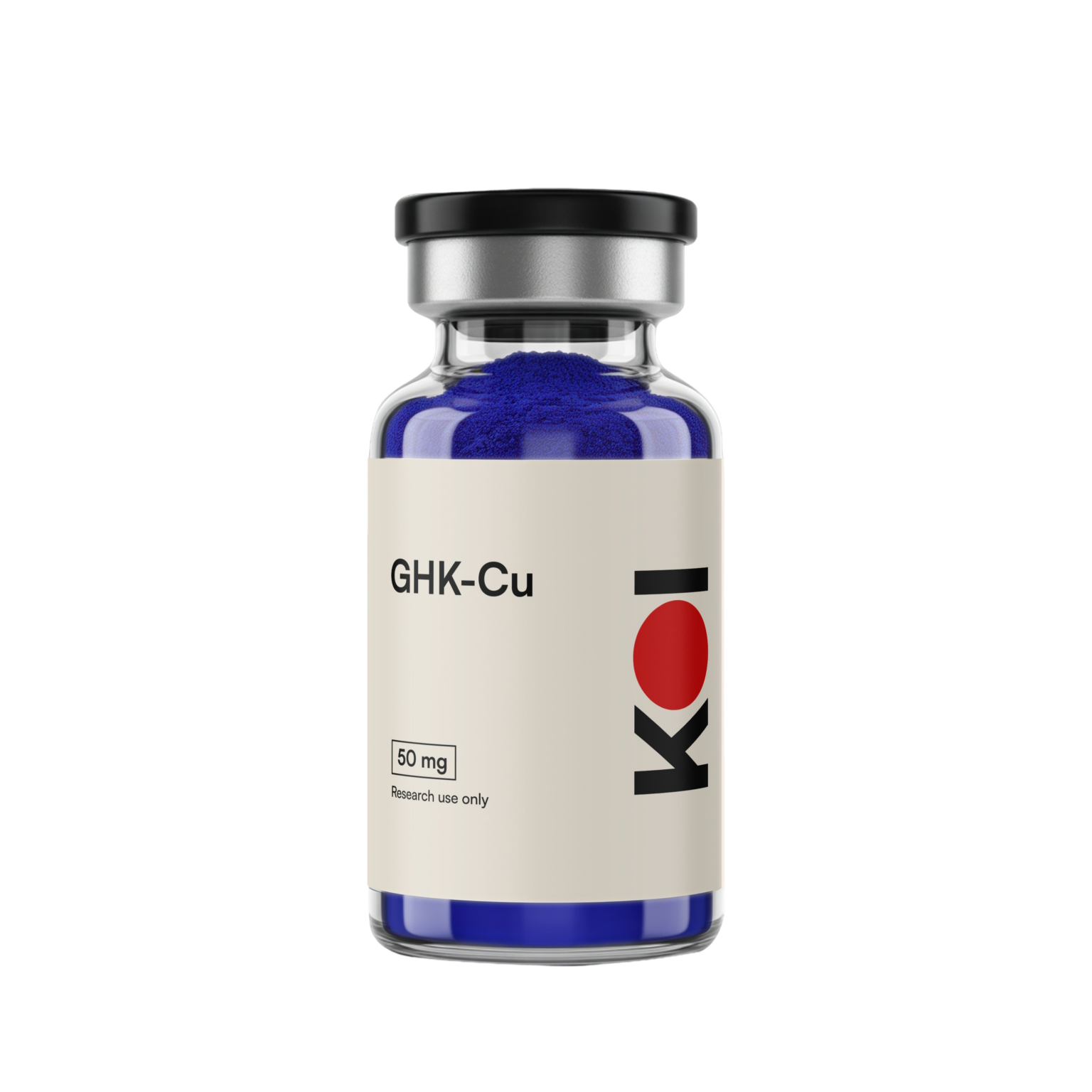
GHK-Cu is a naturally occurring copper-binding tripeptide — glycyl-L-histidyl-L-lysine (Gly-His-Lys) complexed with a copper(II) ion. First isolated from human plasma, the tripeptide binds Cu²⁺ with high affinity and acts as a copper carrier, delivering the metal into cells in a redox-controlled form. The copper coordination gives the complex its characteristic deep-blue color. GHK-Cu is widely used as a cosmetic ingredient; it is not an FDA-approved drug.
Research areas where laboratories buy GHK-Cu for in vitro work include collagen, decorin and matrix-metalloproteinase gene expression in dermal fibroblast cultures, peptide–metal coordination chemistry and copper-binding affinity, antioxidant-pathway profiling such as superoxide-dismutase induction, and comparative studies of GHK-Cu against the free GHK tripeptide. The material supplied here is research-grade for in vitro laboratory study only.
Every lot, independently verified
Compound information
Chemical & structural reference data — specifications, molecular profile and handling.
GHK-Cu Mechanism of Action
- Chelates Cu²⁺ in a square-pyramidal coordination geometry, with labile axial positions available for ternary-complex formation.
- Shuttles copper into cells through receptor-mediated and passive pathways, stabilizing copper in a redox-controlled form.
- Modulates expression of collagen, decorin, elastin and matrix-metalloproteinase genes in dermal fibroblast cultures.
- Engages antioxidant-response networks, including superoxide dismutase and proteasome-associated gene expression.
- Active at picomolar–nanomolar concentrations on collagen synthesis in fibroblast cultures.
- Releases copper to apo-enzymes and copper-dependent transcription factors — a ‘carrier-peptide’ role in controlled-stoichiometry delivery.
GHK-Cu Research Applications
- Collagen, decorin and matrix-metalloproteinase gene expression in dermal fibroblast cultures.
- Comparative analysis of GHK-Cu vs the free GHK tripeptide, with and without exogenous copper.
- Peptide–metal coordination chemistry and copper-binding affinity under defined buffer / pH conditions.
- Antioxidant-pathway profiling, including SOD induction and proteasome-associated gene expression.
- Dermal fibroblast proliferation, keratinocyte signaling, and wound-closure assays.
- Stability and structure–activity studies of the GHK-Cu complex under defined storage and pH.
Why Buy GHK-Cu from Koi Peptides?
- Every batch of Koi GHK-Cu is synthesized and lyophilized in the United States, then released against independent third-party laboratory (Freedom Diagnostics Testing) testing.
- Each lot is tested by HPLC for purity, LC-MS for identity confirmation, and endotoxin assay for sterility readiness.
- The lot ID is printed on every vial and ties back to a public COA library, so researchers can verify documentation before they buy and after the vial arrives.
- Orders placed before 2 PM CT ship the same business day, and shipping is free on orders over $200.
- Pickart, L., & Thaler, M. M. (1973). Tripeptide in human serum that prolongs survival of normal liver cells. Nature New Biology, 243(124), 85–87. doi.org/10.1038/newbio243085a0
- Pickart, L., et al. (1980). Growth-modulating plasma tripeptide may function by facilitating copper uptake into cells. Nature, 288(5792), 715–717. doi.org/10.1038/288715a0
- Pickart, L., & Margolina, A. (2018). Regenerative and protective actions of the GHK-Cu peptide. International Journal of Molecular Sciences, 19(7), 1987. doi.org/10.3390/ijms19071987
- Hureau, C., et al. (2009). Coordination chemistry and redox conversion of copper complexes. J. Biological Inorganic Chemistry, 14(7), 995–1000. doi.org/10.1007/s00775-009-0570-0
- Pickart, L., et al. (2012). The human tripeptide GHK-Cu in prevention of oxidative stress and degenerative conditions of aging. Oxidative Medicine and Cellular Longevity, 2012, 324832. doi.org/10.1155/2012/324832
- Mulder, G. D., et al. (1994). Enhanced healing of ulcers with topical glycyl-L-histidyl-L-lysine copper. Wound Repair and Regeneration, 2(4), 259–269. doi.org/10.1046/j.1524-475X.1994.20406.x
Regulatory Status
FDA, WADA anti-doping, and compounding status — provided for research context.FDA StatusGHK-Cu is not an FDA-approved drug. It is most widely encountered as a cosmetic ingredient in topical skincare formulations, where it is used under cosmetic-ingredient rules rather than as an approved therapeutic. The research-grade material supplied by Koi Peptides is synthesized independently for in vitro laboratory research only — not formulated, packaged, or labeled for human use, not equivalent to or a substitute for any approved drug or cosmetic product, and not authorized for any human or veterinary indication.WADA Anti-Doping StatusGHK-Cu is not named on the WADA Prohibited List and is not specifically tracked under the WADA Monitoring Program. As with any substance, athletes subject to anti-doping rules should confirm current status with their governing body and maintain documentation for any approved use.Compounding Pharmacy StatusKoi Peptides is a chemical research supplier — not a compounding pharmacy or outsourcing facility under sections 503A or 503B of the Federal Food, Drug, and Cosmetic Act — and supplies no compounded preparations of any kind. GHK-Cu supplied here is research-grade material for in vitro laboratory study, not a compounded preparation for human use.DisclaimerFor research use only. Not for human or veterinary use. GHK-Cu is supplied to qualified research professionals for in vitro laboratory study. It has not been evaluated by the FDA and is not intended to diagnose, treat, cure, or prevent any disease. Koi Research Labs LLC is a chemical supplier, not a compounding pharmacy under 503A nor an outsourcing facility under 503B of the Federal Food, Drug, and Cosmetic Act. By purchasing, the buyer agrees this material will not be introduced into humans or animals. Misuse may violate federal, state, or local laws.
MOTS-c 40mg & 10mg (10mg Vial) 


Reviews
There are no reviews yet.