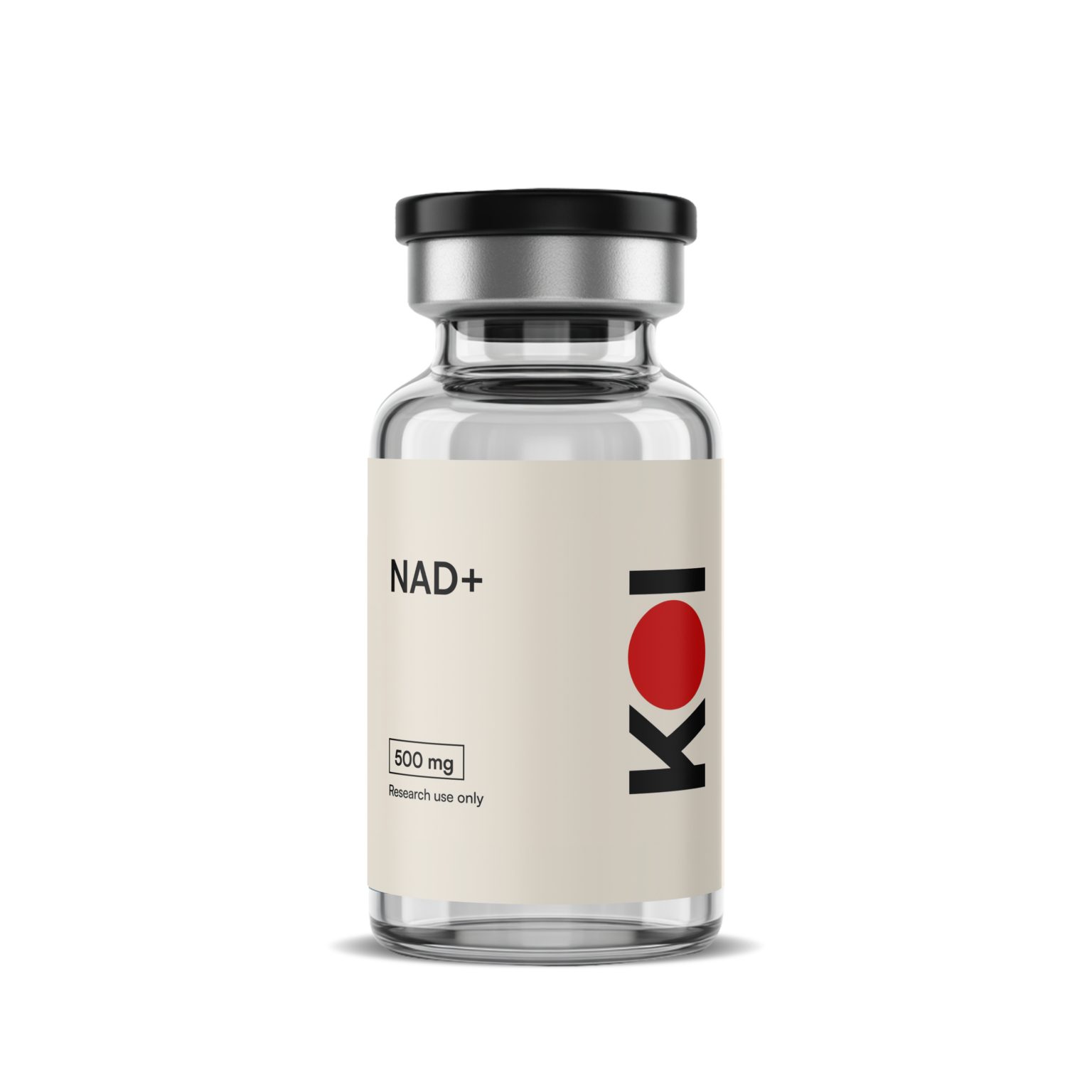
What is NAD+?
NAD+ (β-nicotinamide adenine dinucleotide) is a dinucleotide coenzyme — not a peptide — that sits at the center of cellular redox metabolism. Built from a nicotinamide nucleotide joined to an adenine nucleotide, it cycles between its oxidized form (NAD+) and reduced form (NADH) to shuttle electrons between metabolic reactions. In this role it is the universal electron acceptor for the dehydrogenase enzymes of glycolysis, the citric-acid cycle, β-oxidation, and oxidative phosphorylation.
Beyond redox chemistry, NAD+ is also consumed as a substrate by a family of NAD+-cleaving enzymes — the sirtuins (SIRT1–SIRT7), the poly(ADP-ribose) polymerases (PARP1, PARP2), and the glycohydrolases CD38 and CD157. Research areas where laboratories buy NAD+ for in vitro work include dehydrogenase enzyme kinetics read via the 340 nm NAD+/NADH absorbance shift, sirtuin and PARP activity assays, cell-culture redox studies measuring the NAD+/NADH ratio, mitochondrial bioenergetics, and comparative studies of NAD+ replenishment versus precursor supplementation (NMN, NR, niacin).
Every lot, independently verified
Compound information
Chemical & structural reference data — specifications, molecular profile and handling.
NAD+ Mechanism of Action
- Accepts a hydride (H−) at the C4 position of the nicotinamide ring to convert NAD+ to NADH — the central two-electron transfer step in cellular redox chemistry.
- Acts as the cofactor for dehydrogenase enzymes in glycolysis, the citric-acid cycle, β-oxidation, and oxidative phosphorylation.
- Functions as a substrate for sirtuins (SIRT1–SIRT7), coupling deacylation of histone and protein lysines to NAD+ cleavage and nicotinamide release.
- Serves as the ADP-ribose donor for PARP1 and PARP2 in poly(ADP-ribose) polymerase reactions on damaged DNA strands.
- Provides the substrate for CD38, CD157, and SARM1 — NAD+-cleaving enzymes in calcium signaling, immune activity, and axon-degeneration pathways.
- Sits at the head of a salvage pathway in which nicotinamide is recycled back into NAD+ via NMN through the NAMPT/NMNAT cascade.
NAD+ Research Applications
- Dehydrogenase enzyme kinetics using NAD+ as the electron acceptor, read directly via the 340 nm absorbance shift between NAD+ and NADH.
- Sirtuin (SIRT1–SIRT7) activity assays, where NAD+ is the co-substrate and nicotinamide release is quantified.
- PARP enzyme activity profiling in DNA-damage-response models, with NAD+ as the ADP-ribose donor.
- Cell-culture redox studies measuring the NAD+/NADH ratio across metabolic states using biosensors or mass spectrometry.
- Mitochondrial bioenergetics — how NAD+ availability influences electron-transport-chain flux, oxygen consumption, and ATP synthesis.
- Comparative studies of NAD+ replenishment versus precursor supplementation (NMN, NR, niacin) across cell types.
Why Buy NAD+ from Koi Peptides?
- Every batch of Koi NAD+ is manufactured and lyophilized in the United States, then released against independent third-party laboratory (Freedom Diagnostics Testing) testing.
- Each lot is tested by HPLC for purity, LC-MS for identity confirmation, and endotoxin assay for sterility readiness.
- The lot ID is printed on every vial and ties back to a public COA library, so researchers can verify documentation before they buy and after the vial arrives.
- Orders placed before 2 PM CT ship the same business day, and shipping is free on orders over $200.
- Belenky, P., et al. (2007). NAD+ metabolism in health and disease. Trends in Biochemical Sciences, 32(1), 12–19. doi.org/10.1016/j.tibs.2006.11.006
- Bernofsky, C., & Swan, M. (1973). An improved cycling assay for nicotinamide adenine dinucleotide. Analytical Biochemistry, 53(2), 452–458. doi.org/10.1016/0003-2697(73)90094-8
- Imai, S., & Guarente, L. (2014). NAD+ and sirtuins in aging and disease. Trends in Cell Biology, 24(8), 464–471. doi.org/10.1016/j.tcb.2014.04.002
- Bai, P. (2015). Biology of poly(ADP-ribose) polymerases. Molecular Cell, 58(6), 947–958. doi.org/10.1016/j.molcel.2015.01.034
- Verdin, E. (2015). NAD+ in aging, metabolism, and neurodegeneration. Science, 350(6265), 1208–1213. doi.org/10.1126/science.aac4854
- Covarrubias, A. J., et al. (2021). NAD+ metabolism and its roles in cellular processes during ageing. Nature Rev. Mol. Cell Biol., 22(2), 119–141. doi.org/10.1038/s41580-020-00313-x
- Chini, C. C. S., et al. (2020). CD38 ecto-enzyme regulates NAD+ and NMN levels in aging. Nature Metabolism, 2(11), 1284–1304. doi.org/10.1038/s42255-020-00298-z
- Cambronne, X. A., et al. (2016). Biosensor reveals multiple sources for mitochondrial NAD+. Science, 352(6292), 1474–1477. doi.org/10.1126/science.aad5168
- Yoshino, J., et al. (2018). NAD+ intermediates: the biology & therapeutic potential of NMN and NR. Cell Metabolism, 27(3), 513–528. doi.org/10.1016/j.cmet.2017.11.002
Regulatory Status
For research use only. Not for human or veterinary use. NAD+ is supplied to qualified research professionals for in vitro laboratory study. It has not been evaluated by the FDA and is not intended to diagnose, treat, cure, or prevent any disease. Koi Research Labs LLC is a chemical supplier, not a compounding pharmacy under 503A nor an outsourcing facility under 503B of the Federal Food, Drug, and Cosmetic Act. By purchasing, the buyer agrees this material will not be introduced into humans or animals. Misuse may violate federal, state, or local laws.
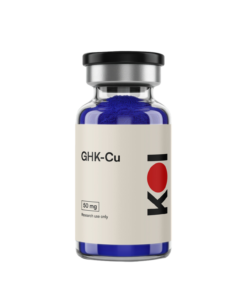
NAD+ (500mg & 1000mg) (500mg Vial) 


Reviews
There are no reviews yet.